How to Flatten a Whetstone (And Why It Matters for Sharpness)
A sharp knife doesn’t start with the blade—it starts with the stone.
Many home cooks and even experienced chefs invest in high-quality Japanese knives, learn proper sharpening angles, and practice consistent technique—yet still struggle to achieve clean, refined edges. Often, the missing piece is deceptively simple: a flat whetstone.
Whetstones wear unevenly over time. If your stone isn’t flat, your knife edge won’t be either. In this guide, you’ll learn how to flatten a whetstone properly, why it directly affects sharpness, and how professionals maintain their stones to achieve consistent results.
Why Whetstone Flatness Directly Affects Knife Sharpness
When sharpening, your blade is only as precise as the surface it contacts. A flat stone ensures:
- Consistent edge angles
- Even steel removal
- Predictable burr formation
- Clean, straight bevels
An uneven stone introduces micro-variations in angle that lead to:
- Rounded edges
- Inconsistent sharpness
- Premature dulling
- Difficulty progressing through grits
In professional kitchens and traditional Japanese sharpening environments, stone flatness is treated as non-negotiable maintenance, not an optional step.
What Happens When a Whetstone Becomes Uneven
Whetstones naturally dish in the center due to repeated strokes in the same area. Over time, this creates a concave surface.
Common symptoms include:
- The knife feels sharp but won’t hold an edge
- Uneven bevel width along the blade
- Difficulty deburring
- Slower sharpening progress
If sharpening feels frustrating or unpredictable, whetstone flattening is often the solution.
How Often Should You Flatten a Whetstone?
There’s no universal rule—it depends on grit, pressure, and frequency of use.
General guidelines:
- Coarse stones (200–600 grit): flatten every 1–2 sessions
- Medium stones (800–2000 grit): every 2–4 sessions
- Fine stones (3000+ grit): every 4–6 sessions
Professional chefs often flatten before every sharpening session to ensure consistency.
A simple test:
If you can see light gaps under a straightedge—or feel wobble under the blade—it’s time to flatten.
Tools You Can Use to Flatten a Whetstone
Diamond Lapping Plates
The gold standard for whetstone flattening.
Advantages:
- Extremely flat
- Fast material removal
- Long-lasting
- Minimal maintenance
Diamond lapping plates are ideal for frequent sharpeners and professionals.
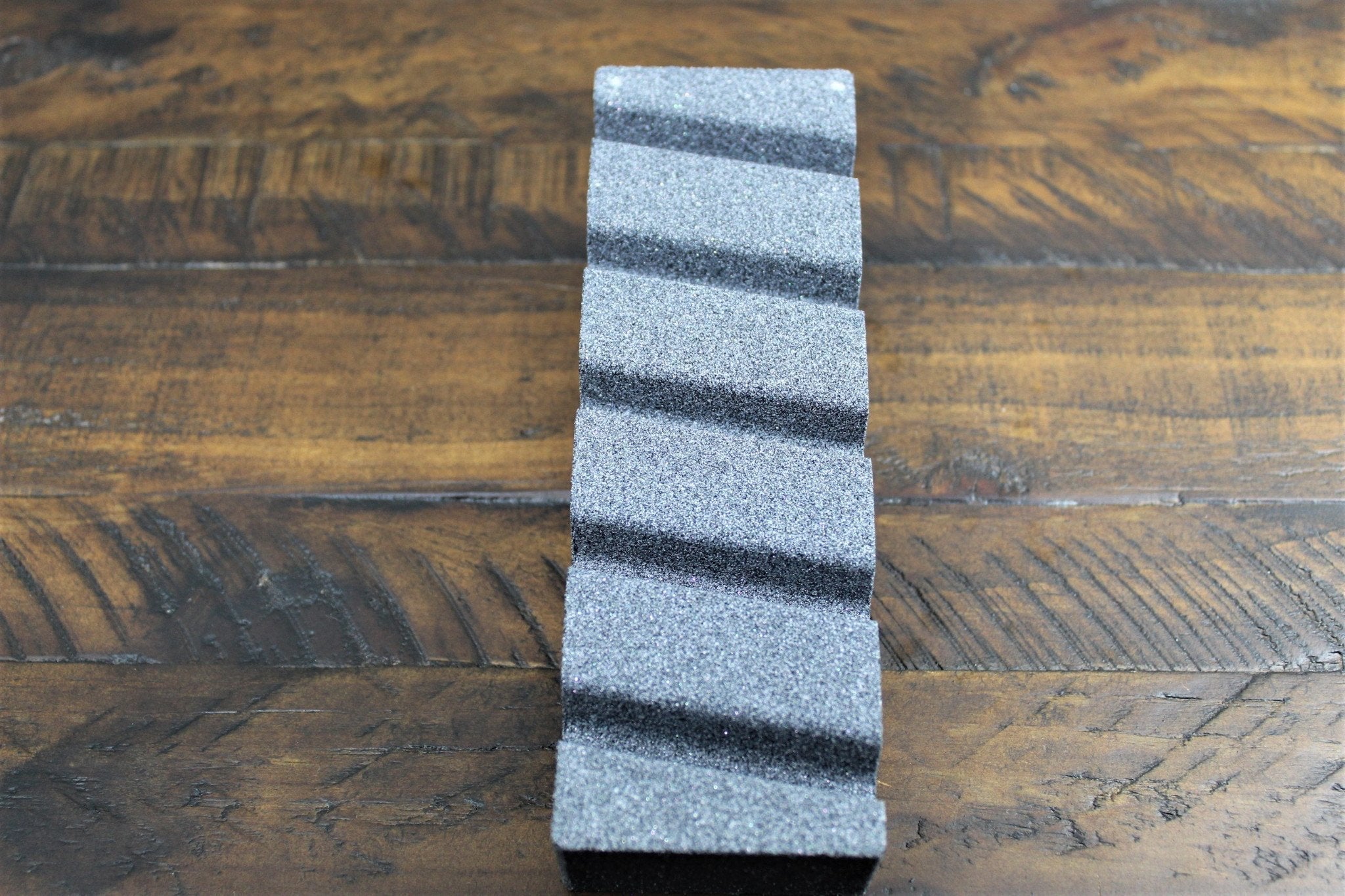
Traditional Flattening Stones
A dedicated silicon carbide stone designed for flattening.
Pros:
- Affordable
- Purpose-built
- Effective with water stones
Cons:
- Wear over time
- Requires periodic replacement

Step-by-Step: How to Flatten a Whetstone Properly
Step 1: Mark the Stone
Draw a grid pattern across the surface with a pencil. This acts as a visual guide.
Step 2: Flatten the Stone
- Wet both the whetstone and lapping plate
- Use light, even pressure
- Move the stone in figure-eight or circular motions
- Continue until all pencil marks disappear
Avoid pressing harder on low spots—let the abrasive do the work.
Step 3: Check Flatness
- Use a straightedge or ruler
- Re-mark and repeat if necessary
Once flat, rinse the stone thoroughly to remove slurry.
Common Mistakes to Avoid When Flattening Whetstones
- Flattening only the center
- Using uneven pressure
- Skipping flattening on fine stones
- Waiting too long between flattening sessions
- Assuming “almost flat” is good enough
Precision sharpening demands precision surfaces.
Professional Sharpening Standards: Why Chefs Flatten Constantly
In professional kitchens, sharpening stones are treated like cutting boards—maintained daily.
Why?
- Consistency matters more than speed
- Knife performance affects prep efficiency
- A flat stone reduces fatigue and guesswork
Stone maintenance isn’t about perfection—it’s about repeatability.
How Proper Whetstone Maintenance Saves Money Long-Term
Flattening your stone:
- Extends stone lifespan
- Reduces steel over-removal
- Protects knife geometry
- Improves sharpening efficiency
A small investment in knife sharpening maintenance pays dividends in blade longevity and performance.
Final Thoughts: Flat Stones, Better Edges
Learning how to flatten a whetstone is one of the most overlooked yet impactful sharpening skills.
If your edges feel inconsistent, your technique may not be the issue—your stone might be telling you it’s time for maintenance.
A flat stone leads to:
- Sharper knives
- Faster sharpening
- Better edge retention
- More satisfying results
And once you experience the difference, you’ll never sharpen on an uneven stone again.